When I first became interested in watchmaking, I quickly started to distinguish between the brands that might one day find a place in my collection — even if that day seemed very far away — and those I could only admire from a distance. At the very top of that second category are luxury independent watchmakers. They represent some of the highest levels of traditional watchmaking, creating objects that bring together expertise, ingenuity, and an extraordinary degree of craftsmanship: from movement design and hand-finishing to chamfering, engraving, and traditional dial-making techniques.
The independent watchmaking scene is booming, and prices can reach truly stratospheric levels for high quality watches. Most enthusiasts will have heard of names like F.P. Journe, Philippe Dufour or Rexhep Rexhepi. We admire their work from afar, fascinated by what they create, but realistically, for most of us, owning one remains more of a dream than a possibility.
So, are we condemned to simply dream about these watches? Or, somewhere within the vast spectrum of independent watchmaking, are there alternatives that offer a little taste of that dream at, shall we say, more reasonable prices?
Well, yes. Of course. High quality artisanal independent watchmaking doesn’t necessarily have to mean six-figure prices. Didn’t you see the title of the article? There is a fascinating middle ground of independent watchmakers and small artisanal brands offering genuinely handcrafted watches for under €5,000.
Before going any further, a few important points
First, let’s talk about the price. Handcrafted work, innovation and artisanal know-how all come at a price — and often a very high one. The watches presented here are certainly not what anyone would call cheap. Compared with the most famous and unobtainable independent watches, however, they offer a good alternative, ranging from relatively accessible pieces to a maximum of around €5,000. And that €5,000 figure puts things into perspective. It is the kind of money you could spend on a watch from a major luxury brand such as Longines, Cartier, Omega or Breitling. But in this case, I find the price has a slightly different meaning. It is, in a way, the price of time: the price of the hours spent designing, machining, finishing, assembling and sometimes even engraving a watch by hand, rather than simply paying for a world-renowned name.
Second, what exactly do I mean by “independent”? This is where things get a little complicated. There is a difference between a microbrand, an independent watchmaker, and an independent watch brand. In this article, when I use the term ‘independent’, I mean a small independent watchmaking brand or atelier — a small-scale operation where the human, artisanal side of watchmaking plays a meaningful role in the production of the watch. This doesn’t necessarily mean developing an entire movement from scratch. A brand can use an existing Swiss movement and still do something genuinely interesting with it: modifying it, decorating it, producing its own components, crafting the dial or case, or simply carrying out a significant amount of the work by hand. For me, that human contribution is the relevant part.
Finally, the boundaries are inevitably blurry. What about a large brand producing a tiny collection of handcrafted “métier d’art” watches? What about an independent brand that develops an in-house caliber but mass-produces its cases elsewhere? And where exactly do we draw the line between artisanal and industrial? We could spend an entire article debating these questions — and perhaps one day we will.
For now, let’s keep things simple. The watches on this list sit somewhere around the boundary between microbrands and luxury independent watchmaking, but they all offer something I find particularly appealing: a tangible sense of craftsmanship and individuality.
And one last thing: this isn’t a ranking of what’s “better.” Mainstream brands and independent watchmakers simply offer different experiences. Some collectors are drawn to history, others to technical innovation, design, finishing, brand reputation or value for money. All of these approaches are perfectly valid. Personally, though, if I had the choice between a Frank Jutzi and a Rolex at the same price, I know where my money would go.
Phew. We’re there. Let’s get to the watches.
Hrotsky: Handmade Watchmaking at Around €2,500
Hrotsky is a fascinating one-man watchmaking operation founded by Alex Hrotsky and built around an impressively hands-on approach. It sits closer to the microbrand end of the spectrum than some of the names on this list but the level of personal involvement makes it impossible to ignore. The watches are produced in tiny, made-to-order batches, with Alex personally handling much of the finishing, regulation, modification and customization. The Flame Blue is a perfect example. Its titanium dial is heat-blued by hand, while the steel hands are hand-ground, polished and finished. Hrotsky uses Swiss-made movements rather than developing its own calibers, but that isn’t really the point. What makes these watches interesting is the amount of craftsmanship that goes into transforming relatively conventional components into something genuinely personal.
At around €2,500, the Flame Blue offers a surprisingly artisanal take on independent watchmaking without coming anywhere near the prices of traditional high-end independents. And, most importantly, it’s absolutely gorgeous.

Sartory-Billard: Bespoke Watchmaking From €3,000
Sartory-Billard is a French independent watchmaker whose philosophy revolves around two things: craftsmanship and, above all, personalization. With operations in both France and Switzerland, the brand produces only a few hundred watches a year, with Armand Billard personally crafting the dials and assembling the watches in his French workshop. Many components and specialized crafts — including guilloché, cases and movements — are entrusted to carefully selected Swiss and European specialists. But the final watch is brought together by hand, with an unusually high level of customization.

The SB04 is the most accessible entry point, starting at around €3,000, while bespoke configurations start at around €4,000. Sartory-Billard is a compelling proposition for collectors looking for a genuinely personal, handcrafted watch rather than a mass-produced watch.

Kieser Design: Remarkable In-House Manufacturing
Kieser Design is an unusually hands-on German brand because a large part of the watch is actually made in-house. Based in Frankfurt, Matthias Kieser and his small team manufacture the case, titanium dial, hands, indices, crown and clasp themselves, while also handling machining, anodizing and finishing. Even the distinctive exoskeleton case and intricate honeycomb dial are produced in their own workshop. The movement is based on the Swiss-made SW200 and is customized with a Kieser-designed rotor and additional finishing. The result is a remarkably vertically integrated approach, combining modern engineering with a surprising amount of traditional craftsmanship.
With the current tragwerk2.0 priced at €4,950, Kieser Design offers an impressive level of in-house manufacturing for the money. And there is something particularly satisfying about knowing just how much of the watch actually comes from the people behind the brand.

Holthinrichs: Sculptural Cases, 3D Printing and Artisanal Finishing
Holthinrichs is a fascinating Dutch independent brand where craftsmanship and modern technology go hand in hand. Founded by Michiel Holthinrichs, the brand is particularly known for its highly sculptural cases, combining traditional hand-finishing with advanced 3D-printing and machining techniques.
The cases are produced using a combination of advanced machining and, on selected models, 3D printing, before being extensively hand-finished with polishing, angling and intricate decorative details giving each watch a distinctly artisanal character.
The movements are sourced from Swiss manufacturers and customized to Holthinrichs’ specifications, including bespoke rotor designs and finishing. And this is what makes the brand so interesting to me: it doesn’t try to choose between traditional craftsmanship and modern technology. Instead, it uses technology to create shapes that would be difficult or even impossible to produce conventionally, before relying on human hands to give them their final character.
With models such as the Ornament starting at around €3,500, Holthinrichs offers an impressive level of craftsmanship at a price that, while certainly not inexpensive, remains remarkably accessible by independent-watchmaking standards.
And yes, it’s probably my favorite on this list. I mean… look at these cases!

Aurelia Horology: Haute Horlogerie at Around €5,000
Aurelia Horology is an Austrian independent watchmaking atelier founded in 2024 by master watchmaker Benedikt Prand-Stritzko, former development engineer at H. Moser & Cie and Hautlence.
The brand combines traditional hand-finishing with contemporary movement development, producing highly limited-production timepieces. While using an existing movement architecture, Aurelia delivers an extraordinary level of re-engineering.
The movement architecture is based on the well-known Unitas 6497/6498 family, but Aurelia extensively re-engineers the base, redesigning and rebuilding much of the movement — retaining virtually nothing beyond the gear train — while adding extensive hand-finishing. The bridges are entirely hand-engraved and hand-beveled, giving the movements a level of visual character that is usually difficult to find at this price point. With production currently limited to just a handful of pieces per month, acquiring one requires a little patience — although, judging by the watches themselves, that patience seems well rewarded.
With prices hovering around the €5,000 mark, it technically breaks the rules of this selection. Yet, given the level of craftsmanship on display — truly reminiscent of high-end independent watchmaking at a fraction of the cost — I simply couldn’t leave it out. Think of it as a brief, justifiable detour into the upper tiers of independent craftsmanship.

A little piece of the dream
Luxury Independent watchmaking can sometimes feel like a distant universe reserved for a very fortunate few. But as we’ve seen, the reality is a little more nuanced. You don’t necessarily need to spend the price of an apartment to experience some of what makes independent watchmaking so fascinating. A beautifully finished movement, a handcrafted dial, an unusual case, a traditional technique, or simply an obsessive attention to detail can already bring a little bit of that magic to your wrist.
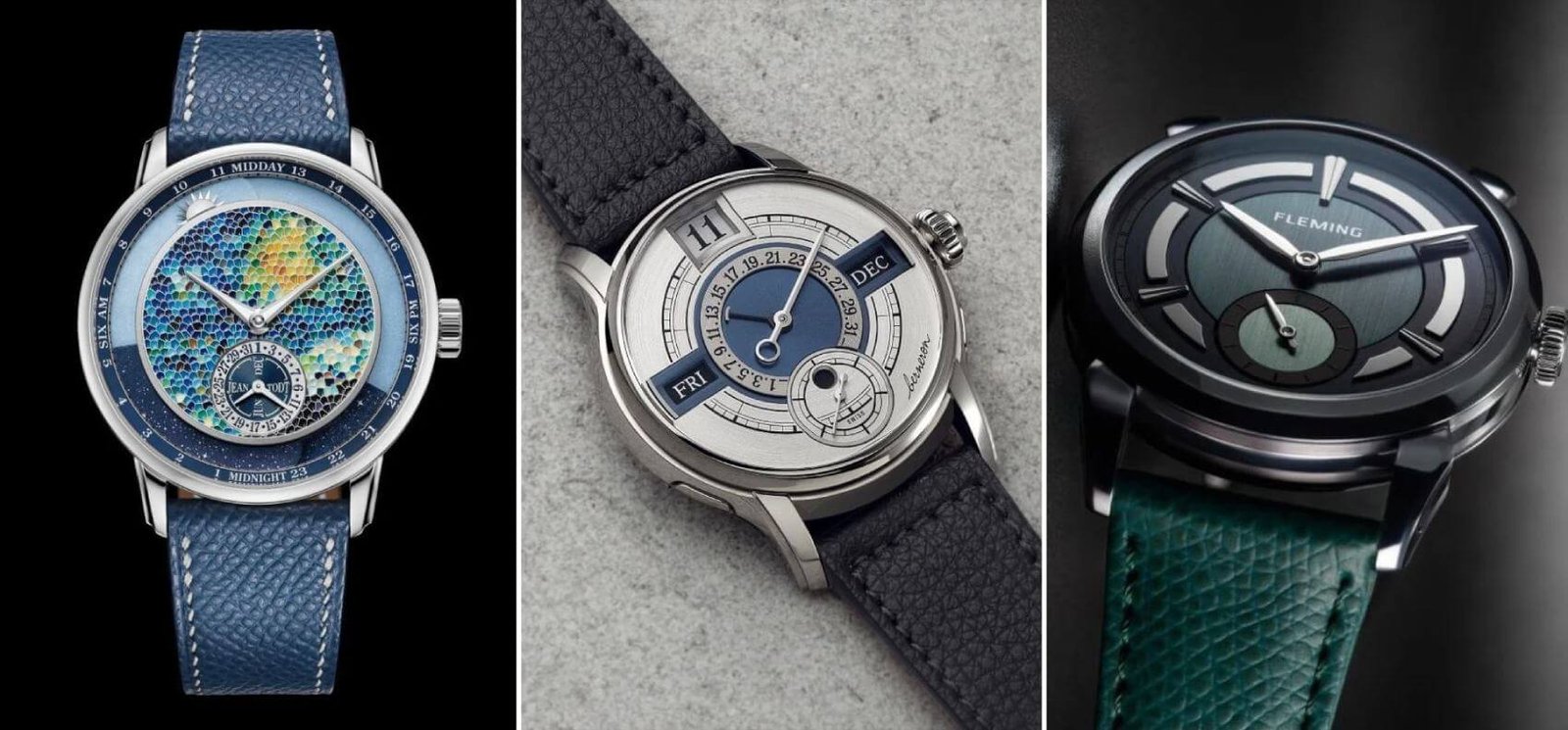
And perhaps that’s what I find most exciting about this part of watchmaking. The magic isn’t necessarily in the price tag. It’s in knowing that somewhere along the way, someone cared enough to do things differently. So, if a Laurent Ferrier, a Krayon or a Berneron still feels like a distant dream, don’t worry. There are plenty of smaller dreams within reach.
And who knows? Maybe one day, one of those “impossible” watches will actually find its way into your collection. Until then, there are plenty of dreams you can afford.