I’m not going to beat around the bush: the moonphase is, by far, my favorite complication. It’s also my oldest watchmaking memory. I still have this vague, fleeting memory of my father’s watch—and of my sheer disbelief, followed only by fascination, at the sight of that little moon smiling back at me. That’s where my passion started.
For a watch enthusiast, though, it’s a bit of a nightmare. Among the simpler complications—unless we’re talking about the truly twisted stuff from high-end watchmaking, which is an altogether different ballgame—the moonphase is probably one of the least common. It’s much easier to be a fan of a 3 o’clock date window or the rotating bezel. And if you’re reading this, there’s a good chance you’re a bit like me. You’re in the right place, my friend.
3 reasons why the moonphase is obviously the greatest complication of them all
1— Useless, therefore essential (like a watch, really)
There is something wonderfully poetic about a complication being completely useless. But hear me out. A moonphase is a mechanical complication that requires extra work from the movement. It adds complexity and arguably moves it further away from its most basic goals: reliability and efficiency. It’s a sacrifice made purely for beauty. A statement. A love letter to the Arts. Poetry. And that’s what makes it so fascinating.
It isn’t there simply because it looks nice; it says something about watchmaking itself. History, technique, art—it brings all three together in a single complication, and then has the audacity to give itself only one real purpose: pure pleasure.
2 — The Moon – The Natural Timekeeper
It’s wonderfully unnecessary, yet somehow perfectly at home on a watch. Because there are three things that have always been, still are, and will probably always remain universal markers of time—even after the nuclear apocalypse, COVID-67, or the dolphins finally rising up against humanity: the sun, the moon, and my son screaming at me in the morning because he wants his bottle.
So, in a way, the moonphase is the only complication with an almost metaphysical right to sit alongside the measurement of time shaped by the sun. You know. The hands. In case you hadn’t figured that out.
3 — It’s damn classy
Honestly, I don’t even have an argument beyond the title. It’s just damn classy. That’s it. We’re talking about something completely subjective anyway. And since I’m writing the article, you’re reading it, and there is no comment section where you can challenge my flawless reasoning… I’m right. You’re wrong. And if anyone dares to challenge these indisputable arguments, I’ll simply remind them that werewolves are real, and that they tend to be a little sensitive.
Now that we’ve established that we’re all in agreement, let’s see what we can actually buy. From affordable quartz moonphases to sophisticated Swiss mechanical watches, these are the models that caught my eye for their design, their approach to the complication, or simply because I couldn’t stop thinking about them.
AV86 1968 Moonphase — Proof that a good moonphase doesn’t have to cost you a kidney. Or, at around €300, at least not one of your working ones.
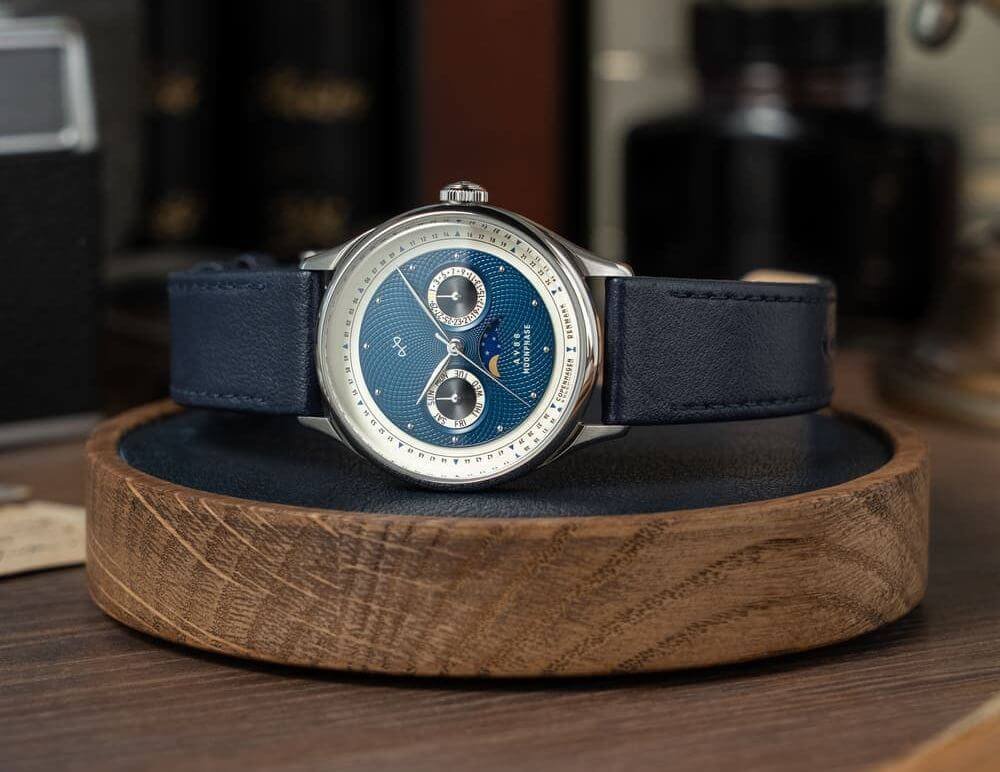
Let’s start strong with this gorgeous watch from the microbrand AV86, formerly known as About Vintage. For the price, you’re not getting a Geneva Seal-certified movement. You get a quartz Miyota 6P20 instead. But you do get a nicely designed watch, good proportions (39mm in diameter and 11.35mm thick), and two other complications: the day and the date.
Perfect ? No. There’s a little detail—or, let’s be honest, a rather ridiculous one—that annoys me just a little. The outer edge of the dial displays the number of every second, except between 25 and 35, because apparently reminding you that this is a Danish brand is more important than counting every single second. But I’ll admit it: it looks pretty damn good.
Selten M1 Moonphase— The €687 watch that clearly understood the assignment.
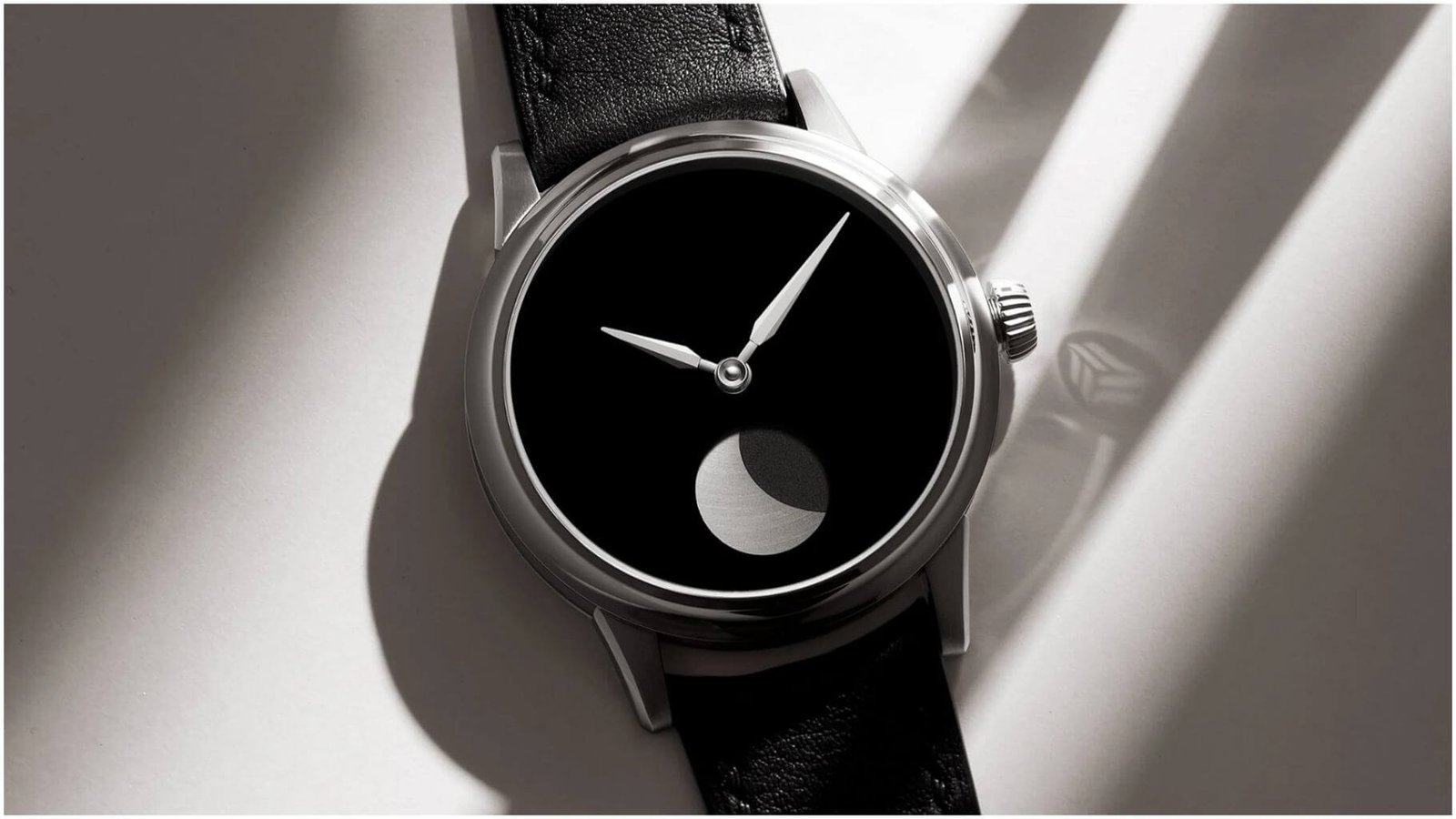
It’s not the first time we talk about this microbrand, but this time let’s focus on the M1 Moonphase model. This watch gets down to the absolute essentials. It just gets it. Hours, minutes, moonphase, and nothing else.
39mm to please the masses, an 11.4mm thickness, a modified Miyota 9015 automatic movement, a custom rotor — it really doesn’t put a foot wrong. Well, almost. The bracelet isn’t anything to write home about, instead put it on black leather and it looks absolutely gorgeous. I particularly love the Musou Black version —with the dial absorbing up to 99.4% of visible light— inevitably bringing to mind deep space. There’s a coherence to this design that I have to point out. If it’s a little too empty for you, there are also CNC-guilloché dials with a mother-of-pearl layer, which at least have hour and minute markers. Other than that, well… They’re empty too! And because Selten doesn’t do things by halves, there’s even a meteorite dial. I can hardly think of anything more fitting for the theme! I’m even forgetting to make jokes now. Must be a phase.
Loresum LS04 V2— €722 — Affordable stone dial with a successful design.
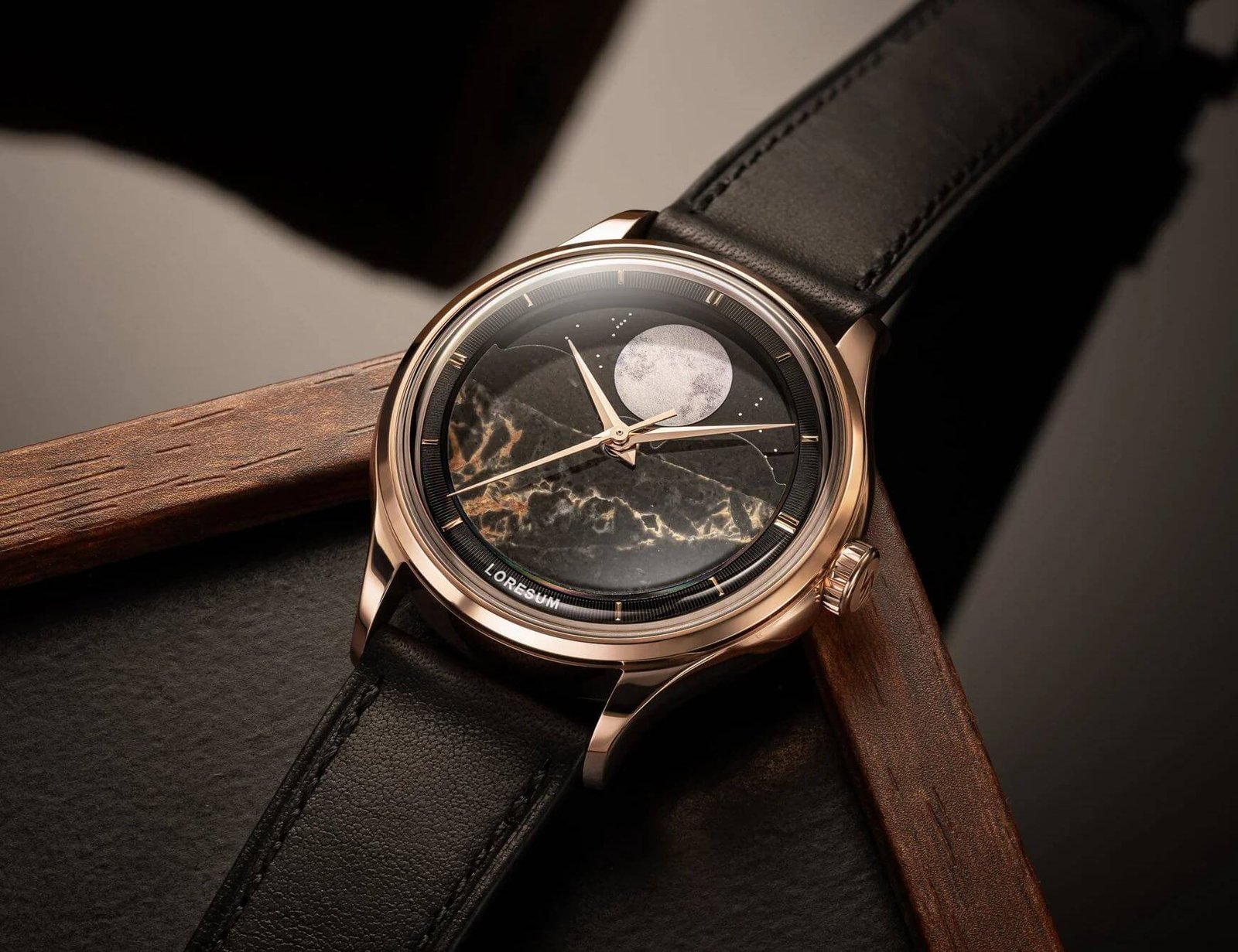
The first version of the LS04 collection may not have had the most inspiring name, but it was already a pretty successful watch. Still, it was missing that little je ne sais quoi that could have made it truly remarkable.
I’m much more in tune with this new version, though. Smaller at 36.5mm in diameter and slimmer at just 11.4mm thick, it takes a more refined, dressier approach—and I certainly won’t complain about that. But the changes don’t stop there. The dial is now made from semi-precious stone—a major trend these days, apparently—with four options to choose from: blue Aventurine, red Garnet, green Bloodstone, and my personal favorite, Eisenkiesel. The latter is black with brown veining that reminds me a little of clouds of gas drifting through space. It’s almost as if the universe decided to decorate the dial itself.
The watch is still powered by the Sellita SW200-1 automatic movement, paired with a dedicated moonphase module and a custom rotor. The movement is also gold-plated, which undeniably adds a touch of charm to the whole package.
And to complete the picture, it is offered at just €722 during the preorder campaign. At this price, I’m so impressed that I’m running out of moon jokes. So, I’ll spare you. For now.
Arcange — 1950s design in a modern €845 watch.
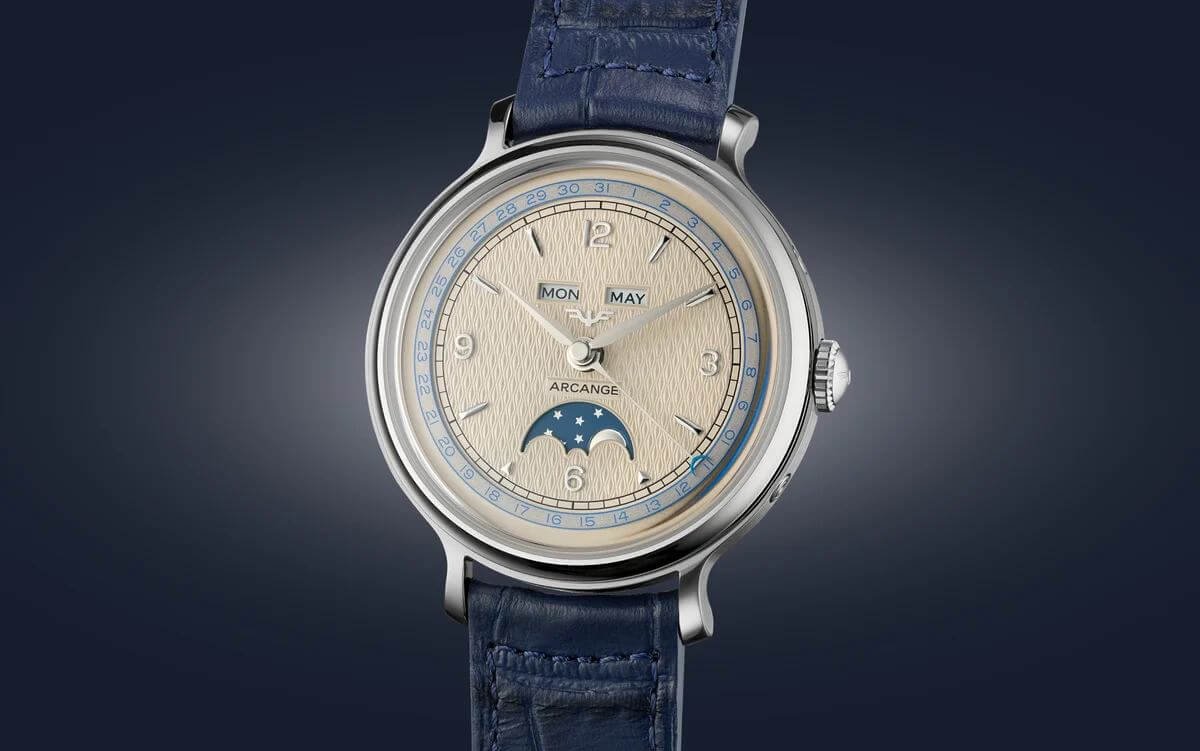
If your idea of heaven involves parrot coat racks, badger-hair shaving brushes, bidets, and corduroy trousers with suspenders, you’re one of those rare people who was simply born in the wrong era. You should have been your grandfather, wearing a triple-calendar moonphase.
The good news is that the recent microbrand Arcange has you covered. You can now have one without worrying about needing a full service the first time it rains. You get proper 5 ATM water resistance, modern proportions (38.5mm in diameter and 11.5mm thick), and a reliable Miyota 9015 automatic movement, while keeping that charmingly old-fashioned — and undeniably cool — design.
The curved lugs, machine-made guilloché dial, pointer date hand and vintage-inspired layout make it the perfect watch for the grandpa you never got to be.
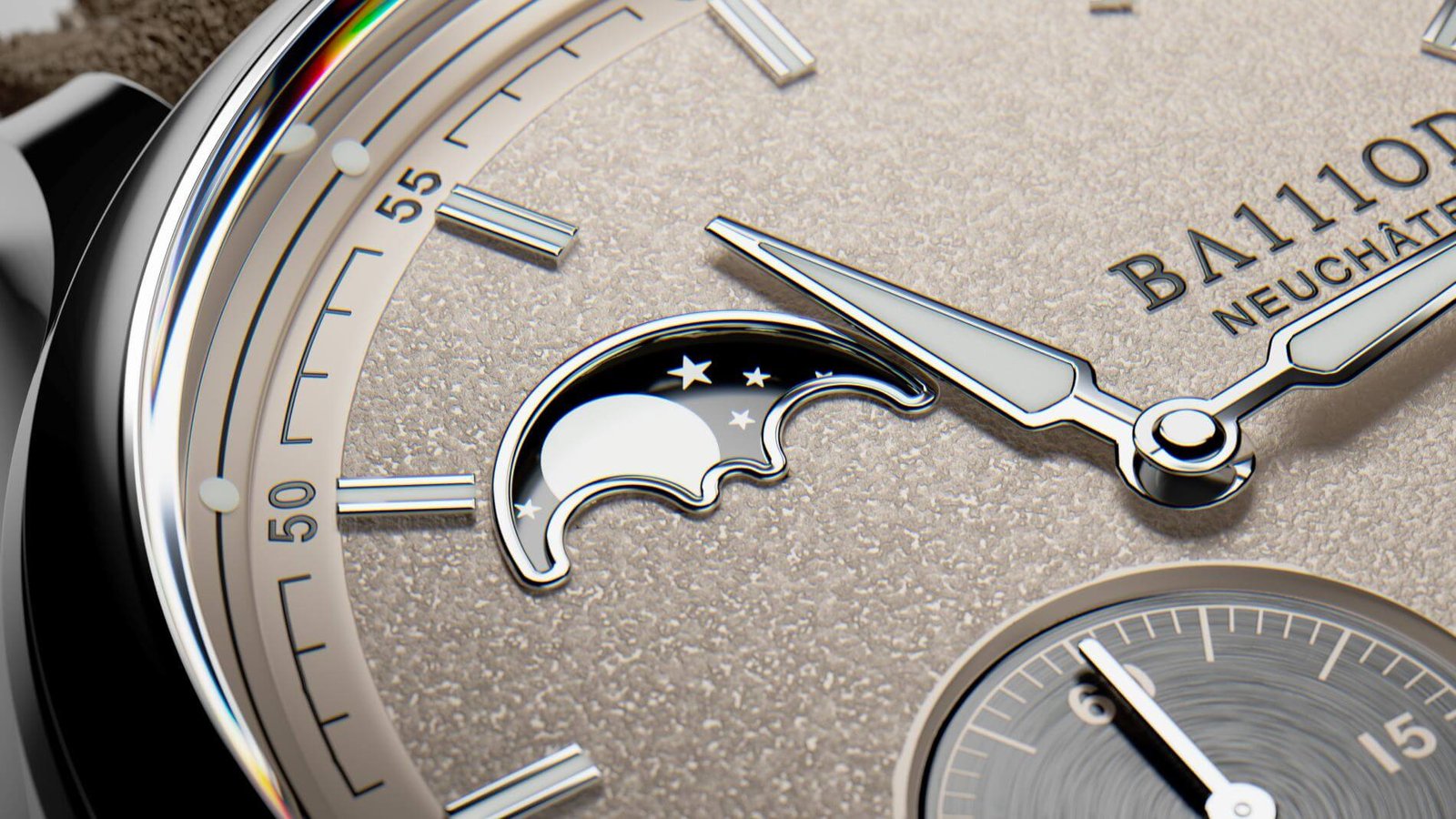
BA111OD— Around €1,180 — Swiss moonlight with a sandy twist.
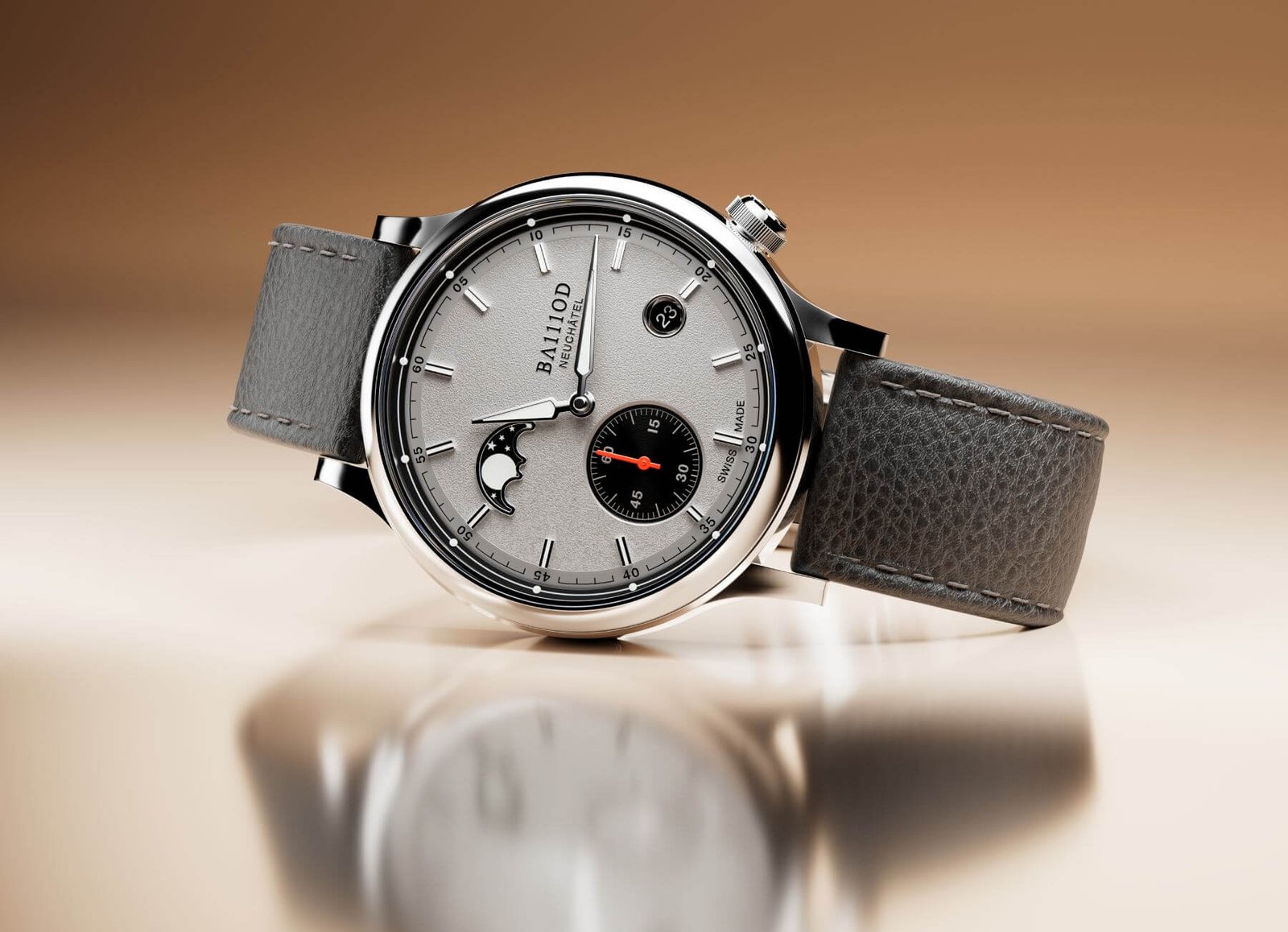
BA111OD’s Chapter 8 Moonphase wraps the moon in a warm, neo-vintage package inspired by the understated elegance of mid-century watches. Unlike the Arcange mentioned above, however, the result is decidedly more contemporary. It is also the largest watch in this selection, with a 41mm case and a thickness of 12.75mm. And yes, I’m thinking of all you hairy lumberjack-wristed people out there! Yet, as someone who rarely strays beyond 38mm, I find it surprisingly easy to wear, thanks in no small part to its reasonable 48mm lug-to-lug.
The asymmetrical dial layout is remarkably balanced and rather original. The moonphase at 10 o’clock, date at 4, and small seconds at 7 make for a configuration you don’t come across every day. And that, ultimately, is part of its charm. This arrangement is in fact that of the Soprod C105 which powers the watch, but rotated by one hour, which also places the crown at 4 o’clock.
There is just one thing I still can’t quite wrap my head — or my tongue — around: the brand name. Oh Louis Moinet almighty, am I the only one who doesn’t speak fluent R2-D2?
MAEN Lunar Classic 36— €1,590 — The moon is literally in the name
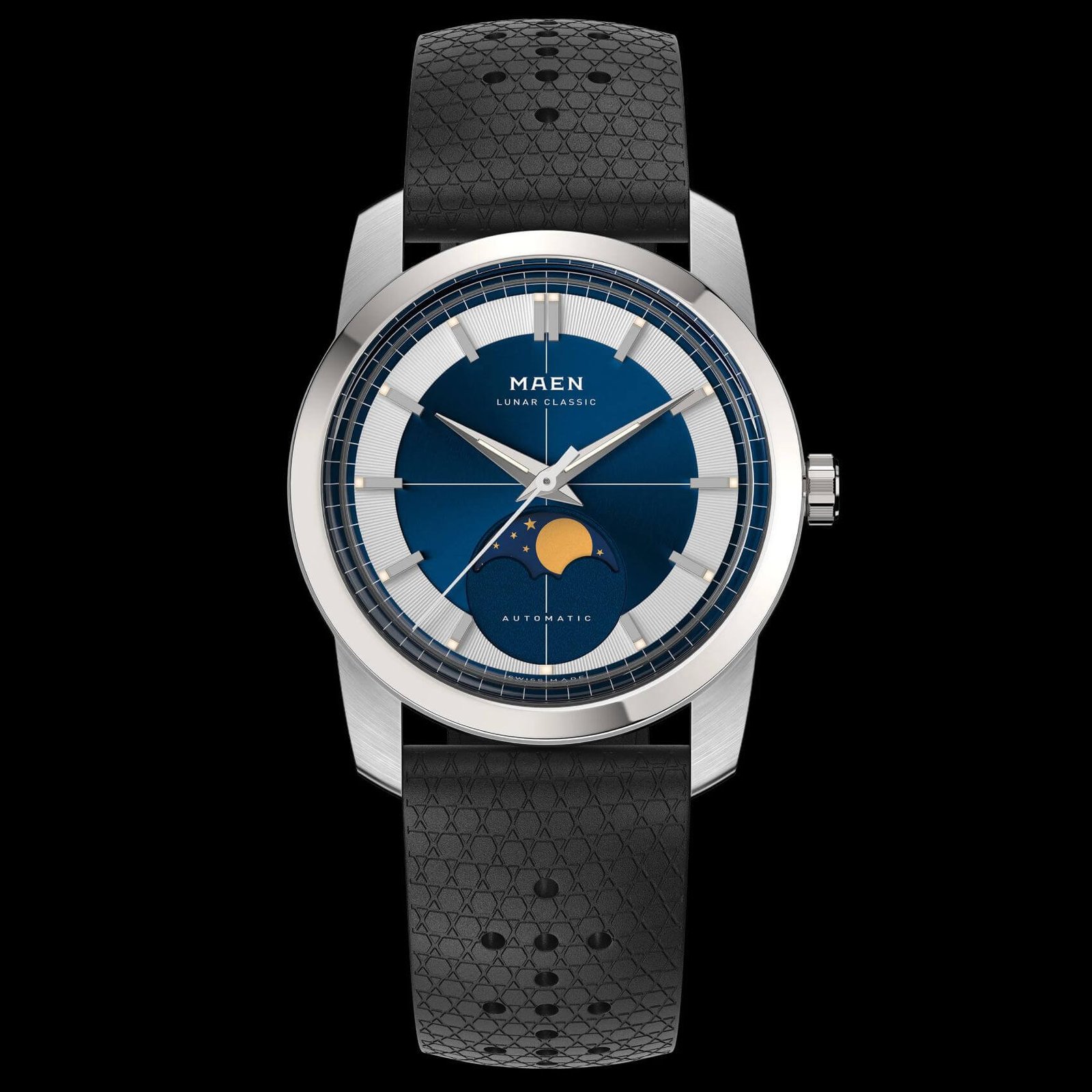
Maen means ‘moon’ in Old Dutch, and the very first watch released by the brand back in 2017 was already a moonphase. The Lunar Classic 36 is therefore less a new chapter than a rather elegant return to the beginning—a cycle, if you will.
Its 1940s-inspired case, long lugs, and domed sapphire crystal give it a decidedly vintage character, while the multi-layered dial keeps things firmly contemporary. It follows a similar formula to the BA111OD mentioned above, but in a more classic style. It has a slimmer profile, measuring just 11.35mm thick and 36mm across (as the name implies; keep up!), more pronounced angles, and a more conventional yet elegant dial, thanks in particular to its two-tone sector finish. Inside beats a Swiss-made Sellita SW280-1 Top Grade movement visible through the caseback, regulated in five positions with a middle rate of 4 ±4 s/d.
Here again, it’s an excellent watch for the price and I don’t have much to criticize, except that, for the love of Abraham-Louis Breguet, why put a Tropic strap on it by default instead of a leather one!?
Mu:n Nuit Des Étoiles— €1,890 — The best watch from a brand entirely dedicated to the moonphase complication.
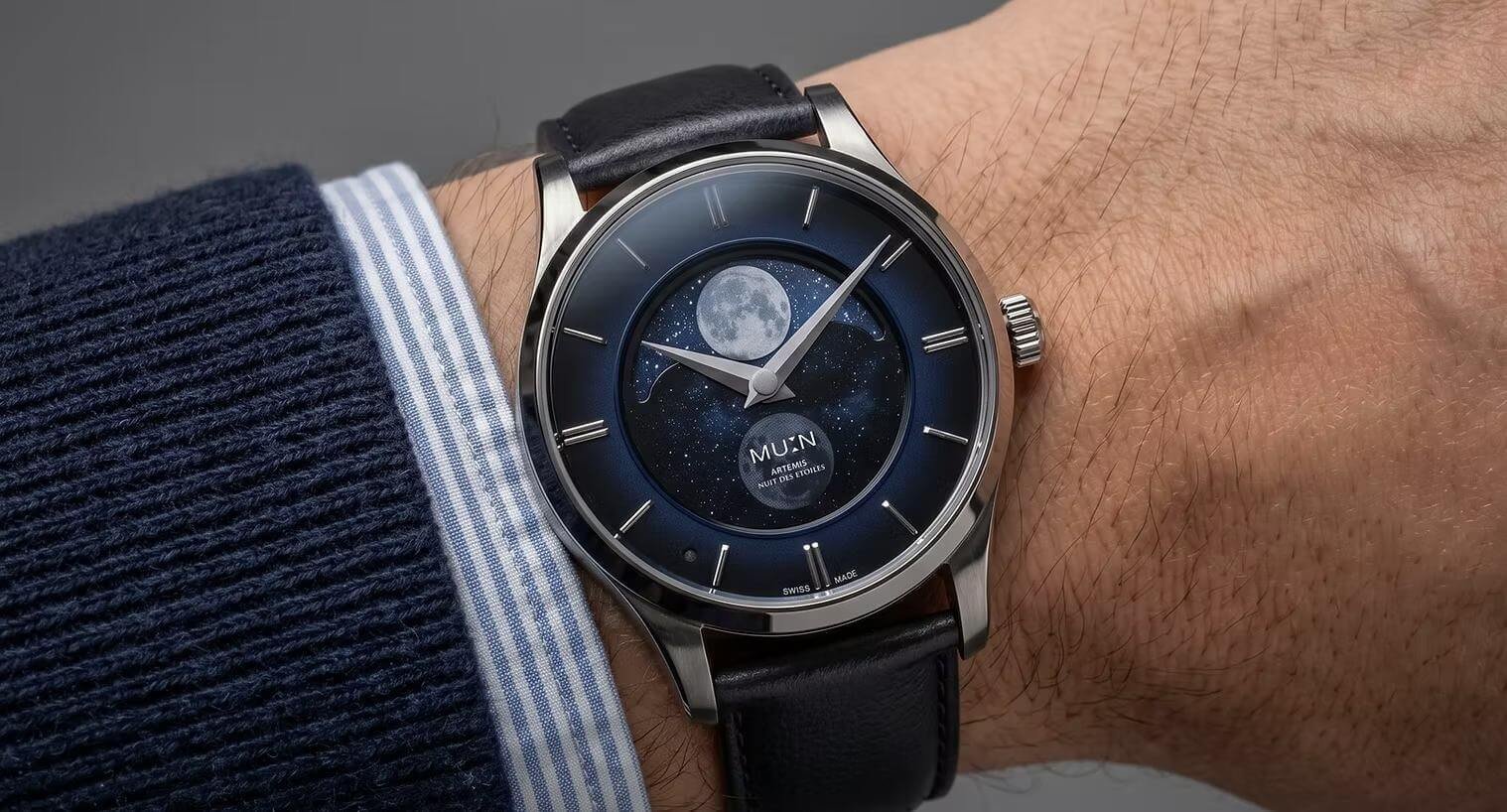
For a Few Dollars More, there’s Mu:n — a french microbrand that seems to have looked at all the complications available in watchmaking and thought: “Nah, the Moon will do.” And honestly, I respect the commitment.
Mu:n’s three collections are therefore all more or less variations of the same watch. They share almost the same dimensions (38mm in diameter), broadly the same movement architecture (Sellita SW288) and, of course, a large moonphase at 12 o’clock.
I hesitated to include it in this list because I wasn’t fully convinced by the first collections, but the latest iteration completely won me over. A cleaner dial, more elegant hands, and above all, the seconds hand, designed to look like a tiny satellite orbiting the moon. Look closely, it’s that little dot right there at the edge of the dial!
Elegant, original, and perfectly in line with the theme: I love it. If you like it too, don’t wait too long, this watch is limited to 300 pieces.
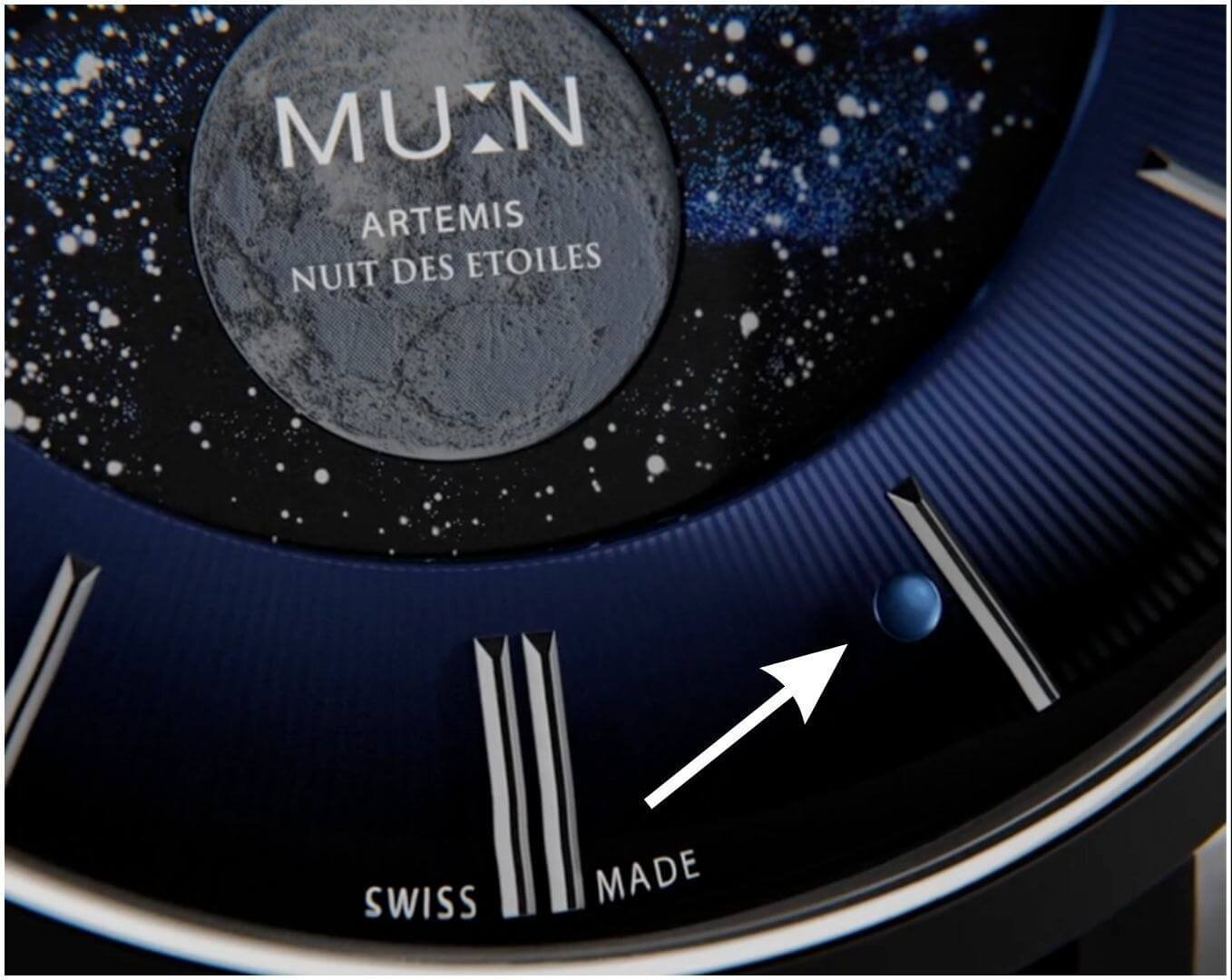
They didn’t just add a moonphase to an otherwise ordinary watch. No, Mu:n put a watch around a moonphase. Honestly, I think they’ve earned the right to be a little lunatic. Yes, I know. Moon jokes again…
Farer Stratton Moonphase— The best of the best at around €2,100 (no jokes here: this watch means business).
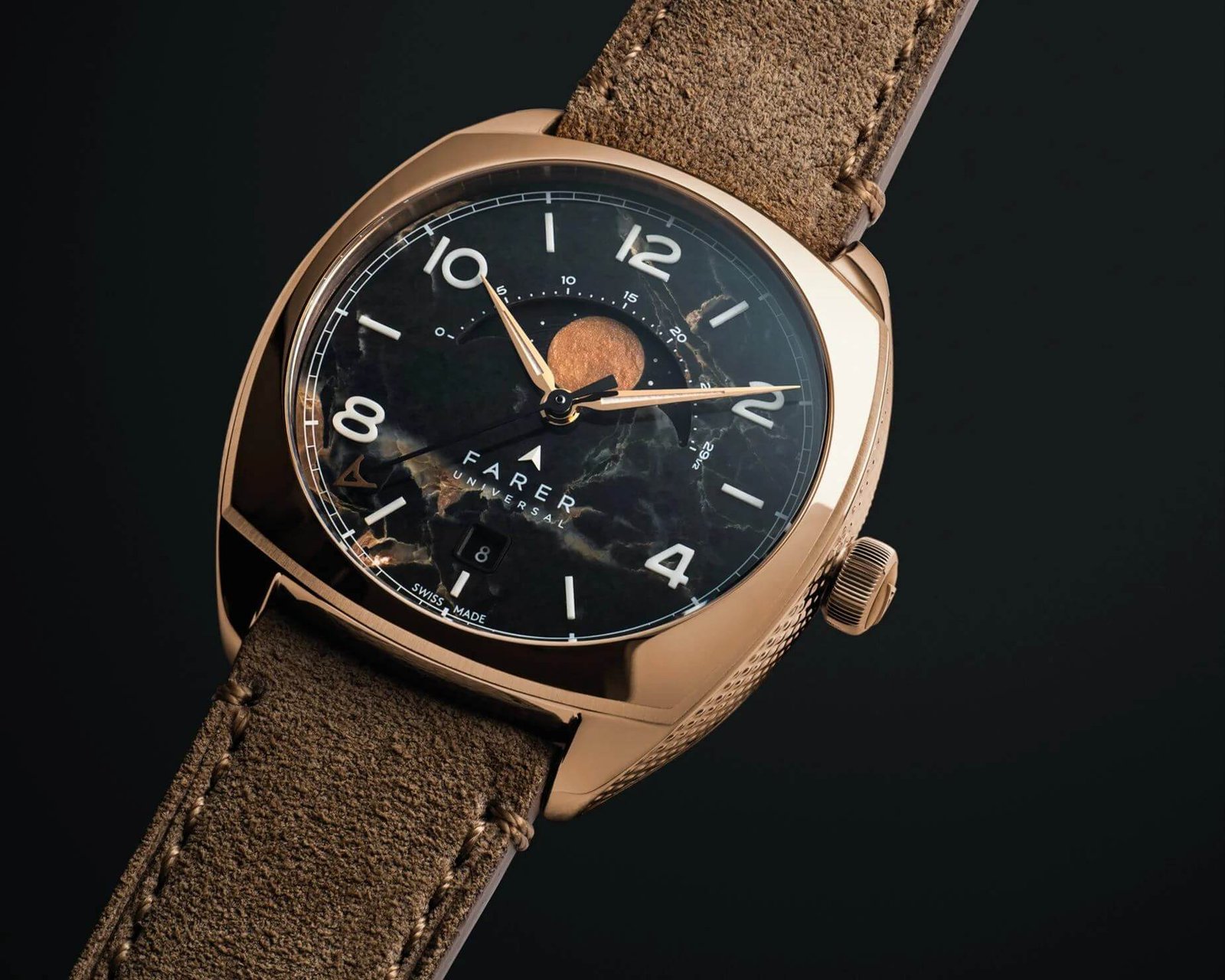
Yes, I’ve gone over €2,000. But I do what I want. It’s my article. Now, seriously, don’t get me started on this watch. I could talk about it all night, and if I’m being completely honest, this entire paragraph is hopelessly biased. I own one myself—the blue Burbidge—and it’s quite simply one of my favorite watches in my collection. The cushion-shaped case is gorgeous, comfortable, and well balanced at 11.5mm thick for 38.5mm across.
The case sides are also decorated with an unusual texture. The moonphase disc is luminescent and hand-painted, adding a touch of craftsmanship to an already fascinating watch. Then there’s the hand-wound Sellita SW288-1 M Elaboré Grade movement, blued screws, and a bespoke Farer embossed-patterned bridge. Put it all together and you’ve got one of the best watches in the brand’s collection—which is saying something, considering Farer‘s reputation.
And I haven’t even mentioned the dial. Actually, I’m not going to. This is getting long enough already. Just remember this: it’s a fantastic watch, beautifully made, and unfortunately available in a very limited edition. So if you want one, you’d better move fast.
What makes a good moonphase watch?
After all these watches, you might be wondering: what actually makes a good moonphase watch?
Accuracy is one factor. A traditional moonphase follows a lunar cycle of 29.5 days, while the actual synodic month is approximately 29.53059 days. That tiny difference means a classic mechanism will gradually drift and eventually need correcting. This is where the famous 59-tooth and 135-tooth mechanisms come in. The classic 59-tooth system is simple, compact and reliable, while finer gearing can dramatically improve accuracy. Because apparently, even the moon isn’t allowed to be imprecise in the world of watchmaking.
But to me, what matters most is visual integration. A moonphase should feel like part of the dial rather than a decorative afterthought. Its size, position, moon disc and relationship with the other indications can make the difference between elegant and slightly… lunar for the sake of it. Personally, I have a weakness for oversized moonphases but you’ve probably realized that by now!